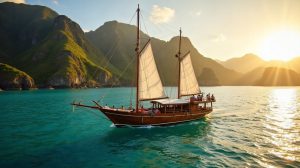
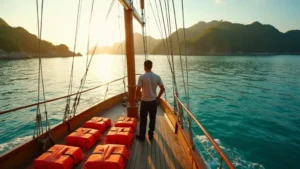
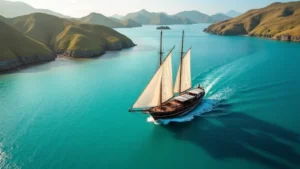
Every evening at dusk, thousands of flying foxes lift off from the mangroves of Kalong Island and stream across the sky above Komodo National Park — and the only front-row seat is the deck of a boat anchored nearby. If you are planning a Komodo cruise for 2027, this guide covers what happens at Kalong each sunset, why it is so reliable, where your boat should anchor, and how to make sure the stop is written into your itinerary before you book.
What Is Kalong Island?
Kalong Island — “Pulau Kalong” means “flying fox island” in Indonesian — is a low, mangrove-covered islet inside Komodo National Park, a short sail from the anchorages most liveaboards use between Labuan Bajo and the park’s headline sites. By day it looks unremarkable: a green smudge of mangrove ringed by shallow water. That is the point. The dense canopy is a daytime roost for an enormous colony of fruit bats, known locally as kalong, which sleep hanging in the trees until the light fades.
On the classic 3D2N route — Padar Island, the dragon trek on Komodo or Rinca, Pink Beach, Manta Point, Taka Makassar — the Kalong mangrove sunset is a favourite optional stop. Crews usually slot it into the first or second evening as the boat repositions toward its night anchorage, so it costs you nothing in daylight hours.
What Happens Every Dusk — and Why It Never Misses
As the sun drops, the first few bats detach from the canopy and flap out over the water. Within ten to twenty minutes the trickle becomes a river: thousands of flying foxes leaving the roost in long ribbons, silhouetted against an orange sky as they head toward the fruit trees of Flores to feed through the night.
The reason this works night after night is simple biology. Fruit bats are nocturnal foragers with a fixed daily rhythm — they roost through daylight and depart at dusk, every day, in every season. Unlike manta rays that depend on currents, or dragons that may be lazing out of sight, the Kalong exodus is not a matter of luck. If you are anchored in position at sunset, you will see it. That reliability is rare in wildlife travel, and it is why experienced crews treat Kalong as a near-guaranteed highlight.
The flight lasts thirty to forty-five minutes, with the densest streams passing overhead in the twenty minutes around sunset.
Why Only Overnight Cruises Can Deliver It
Here is the practical catch: day trips cannot see Kalong at its best. Speedboat day tours from Labuan Bajo must head back to port well before sunset to return guests in daylight — by the time the bats fly, day boats are already at the marina.
The exodus begins at dusk, exactly when an overnight vessel is settling into its anchorage anyway. This makes Kalong one of the strongest arguments for choosing a Komodo overnight cruise over a one-day dash: the 2D1N and 3D2N liveaboard formats put you in the right place at the right hour as a natural part of the route.
On a shared open-trip phinisi, the crew decides whether Kalong fits that departure’s schedule. On a private charter, the boat is yours — tell the captain you want the Kalong sunset and the itinerary bends around it. The vessels running these routes belong to established operators; Komodo Luxury, for example, runs shared and private phinisi departures on this loop through its Komodo sailing tour packages, with boat classes from deluxe phinisi to VIP yachts.
Best Boat Position for the Show
Position matters more than most guests realise. The bats leave the mangroves heading broadly toward the larger islands, so the ideal anchorage puts your deck between the roost and the flight path. Discuss these points with your captain:
- Anchor early. Arrive forty-five to sixty minutes before sunset to secure a good spot before other boats gather.
- West-facing sight lines. The classic image is bats silhouetted against the sunset — position so the western sky sits behind the flight path.
- Keep a respectful distance. Responsible crews keep engines off, avoid floodlights near the roost, and hold voices low as the flight begins.
- Upper deck beats bow. A sun deck or flybridge clears the rigging from your field of view.
Kalong Sunset + Dinner on Deck: The Honeymoon Formula
There is a reason couples name the Kalong evening as the moment of their trip. The boat anchors in glassy water, the chef sets a table on the open deck, the sky turns amber, and as the first course arrives, thousands of bats stream overhead in near silence. No crowds, no schedule — just the two of you and one of Indonesia’s most cinematic natural events.
This pairing — Kalong at dusk followed by a private dinner on deck — is exactly the kind of moment a Komodo honeymoon cruise is built around. On a private charter the crew can go further: a candlelit table for two, a menu agreed with the chef that morning, and the anchorage held overnight so you fall asleep on the same still water.
Low-Light Camera Settings for the Bat Flight
Photographing thousands of fast-moving animals against a darkening sky is challenging, but a few settings improve your keeper rate:
- Shoot early in the flight — the first fifteen minutes offer the brightest sky, and silhouettes against orange are easiest.
- Shutter speed first: start around 1/1000s to freeze wingbeats; drop to 1/500s as light fades.
- Wide aperture, high ISO: f/2.8–f/4 with ISO 1600–6400. A grainy sharp frame beats a clean blurry one.
- Expose for the sky, not the bats — meter on the bright sky so the bats render as crisp silhouettes, with −1 exposure compensation if needed.
- Phone users: lock focus on the island, drag exposure down slightly, and shoot 4K video — pulling stills from footage often beats single photos in this light.
- Then put the camera down for the final ten minutes. The sound and scale are the part no photo captures.
How to Make Sure Kalong Is in Your Itinerary
Because Kalong is an optional stop rather than a fixed inclusion, the most important step happens before you pay a deposit: ask for it explicitly. When you enquire, request “Kalong Island sunset — flying fox flight” in writing on your itinerary and confirm which evening it falls on. On the 3D2N loop this is an easy ask — the island sits close to standard night anchorages.
For context, indicative 2026 pricing: shared 3D2N open trips run from roughly USD 280–500 per person on standard phinisi (budget boats from around USD 150, luxury shared cabins up to about USD 850), while private phinisi charters start from approximately USD 1,800–2,400 per night and climb through USD 2,500–8,000 per night for standard to premium vessels. Rates vary by season and boat class and are confirmed on request. Our team can compare options and lock Kalong into your route via the Komodo cruise booking page.
Frequently Asked Questions
Can I see the Kalong flying foxes on a day trip from Labuan Bajo?
Realistically, no. The bats depart at dusk, and day boats must return to Labuan Bajo before dark. Only overnight cruises — 2D1N, 3D2N, or longer — can anchor near Kalong at sunset and stay for the full flight.
Is the bat flight guaranteed, or hit-and-miss like manta sightings?
It is one of the most reliable wildlife events in the park. Fruit bats leave their roost at dusk every day as part of their feeding rhythm, so a boat anchored in position will see the flight. Weather can soften the sunset colours, but the bats fly regardless.
How long does the flying fox exodus last?
Thirty to forty-five minutes from first departures to last stragglers, with the densest streams in the twenty minutes around sunset. Crews usually anchor about an hour beforehand.
Which itinerary day does Kalong usually fall on?
On the classic 3D2N loop, most crews schedule it on the first or second evening as the boat moves toward its night anchorage after Padar or the dragon trek. On a private charter, you choose the evening.
Is Kalong suitable for a honeymoon or special occasion?
It is arguably the most romantic single moment on the route. Paired with a private dinner on deck at anchor, the sunset flight is a signature honeymoon experience, and private charters can add candlelit settings and tailored menus on request.
Book Your 2027 Cruise With Kalong on the Itinerary
The flying fox sunset costs nothing extra, fails almost never, and turns an ordinary evening at anchor into the memory guests talk about first when they get home. All it takes is an overnight boat and a written itinerary that names the stop. Tell us your dates and group size, and we will recommend the right shared departure or private phinisi and confirm the Kalong mangrove sunset on your schedule. Message us on WhatsApp at wa.me/628113823875 or email [email protected].