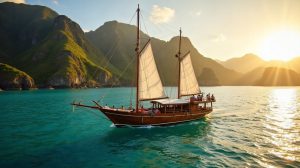
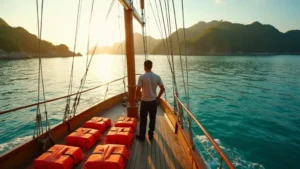
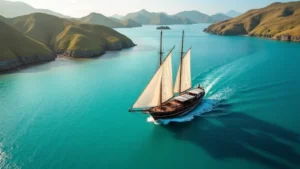
If you have booked an open trip Komodo cruise and are wondering what to expect, here is the honest answer: you will share a traditional phinisi with roughly 8 to 22 travelers from around the world, follow a fixed itinerary through Komodo National Park, and live for two or three days to a rhythm of sunrise hikes, snorkel stops, and sunsets on deck. This guide walks through a typical departure hour by hour — the harbor meeting point, the social side, the daily routine, and the surprises first-timers never see coming — as shared phinisi departures from Labuan Bajo actually run heading into 2027. It is the experience behind the packages on our open trip Komodo cruise page.
Departure Day: The Harbor, the Briefing, and Meeting the Boat
Most open trips begin mid-morning at the Labuan Bajo harbor. Many operators include harbor–hotel transfers, so confirm your pickup the night before; you will usually arrive 30 to 60 minutes early while the crew checks the manifest, loads bags, and runs the safety briefing — life jackets, cabins and bathrooms, meal times, and the plan for day one.
The crew — typically a captain, deckhands, a cook, and a local guide — introduce themselves, and you get your first look at your boatmates: anywhere from 8 to 22 guests from several countries. Then the engine turns over, Labuan Bajo shrinks behind you, and lunch is served underway while the boat quietly sorts itself into deck people, cabin nappers, and the group comparing camera settings at the bow.
The Social Side: Sharing a Phinisi With Strangers From Everywhere
This is the part first-timers underestimate — in a good way. An open trip is booked per person on fixed departures, so the passenger list is a genuine lottery: honeymooners from Germany, two friends from Singapore, a solo backpacker from Canada, a family from Jakarta. Within a day the boat feels less like a tour group and more like a floating common room with much better views.
For solo travelers, this format is hard to beat. You are never forced to socialize — there is always a quiet corner of the deck — but shared meals, snorkel stops, and sunrise hikes create easy, low-pressure ways to meet people, and many guests leave with travel companions for the rest of their Indonesia trip. One note: cabins may be shared or private depending on tier, and light sleepers should treat a private cabin upgrade as the best money spent on an open trip.
The Daily Rhythm: Sunrise Hike, Snorkel, Eat, Repeat
Once underway, life settles into a routine that barely changes between operators, because the classic Komodo loop rewards the same sequence daily.
05:00–08:00 — Sunrise and the First Hike
Wake-up calls come early, usually for the Padar Island viewpoint — a 30 to 45 minute climb, with the three bays lighting up at sunrise. Breakfast is served back on board.
08:00–13:00 — Dragons and Pink Sand
Mid-morning brings the ranger-guided dragon trek on Komodo or Rinca Island, then Pink Beach for snorkeling. Park entrance and ranger fees are often excluded from the cruise price and paid separately, so keep cash ready.
13:00–17:00 — Manta Point, Taka Makassar, and Island Hopping
Afternoons are for the water: mantas at Manta Point when conditions allow, the sandbank at Taka Makassar, and reef stops at Kanawa or Kelor, with the crew shuttling you between boat and reef by dinghy.
17:00–21:00 — Sunset, Dinner, and an Early Night
The boat anchors in a calm bay, dinner is served family-style, and evenings end early. Some itineraries add a sunset stop at Kalong to watch thousands of flying foxes leave the mangroves — for many guests an unexpected highlight.
To compare how this rhythm stretches across one, two, or three nights at sea, our Komodo overnight cruise guide breaks down the 2D1N and 3D2N formats in detail.
What First-Timers Do Not Expect
These practical realities surprise people most.
Phone Signal Is Limited or Gone
Once you leave Labuan Bajo, mobile coverage turns patchy and disappears around many anchorages. Some higher-tier boats offer wifi, but on a typical open trip plan to be offline for most of the voyage. Download maps, music, and books before departure.
Fresh Water Runs on a Schedule
Phinisi carry limited fresh water tanks. On budget boats, showers may be brief, timed, or limited to certain hours, and rinsing off after every snorkel is not always possible. Midrange boats manage this better, but water discipline is part of boat life at every tier.
Bathrooms Are Shared — and There May Be a Queue
On budget open trips, two to four bathrooms can serve the whole guest list, and the pinch points are predictable: before the sunrise hike and after the last snorkel. Shower off-peak and it is a non-issue.
The Itinerary Bends to the Sea
Manta sightings depend on conditions, and captains adjust routes for swell and wind. A good crew always delivers the core highlights, but the exact order — and occasionally a stop — can change.
Budget vs Midrange: What the Extra Money Actually Buys
For a 3D2N open trip, budget shared boats are indicatively priced around USD 150–300 per person, while standard and midrange phinisi run roughly USD 280–450. The bands overlap on paper, but the on-board experience differs in concrete ways:
- Cabins: Budget often means shared bunks with fan cooling; midrange typically means private double cabins with air-conditioning.
- Bathrooms: Budget means shared facilities and queues; midrange carries more bathrooms per guest, with en-suites at the top of the band.
- Food: Every tier includes all meals, but midrange galleys serve more variety and handle dietary requests more reliably.
- Guest count: Budget departures fill toward 20-plus; midrange caps lower — more deck space, faster dinghy rotations.
- Extras: Photo and drone documentation and better snorkel gear appear more often on midrange departures.
All figures are indicative, vary by season and vessel, and are confirmed at booking. Both tiers follow essentially the same route — you are paying for comfort and space, not better islands.
Who Should Not Book an Open Trip
Honest advice from a team that sells both formats: consider a private charter instead if any of these apply.
- You want control of the schedule. Open trips run fixed itineraries at fixed times; only a private boat gives you an extra hour at Manta Point or a later start.
- Privacy matters more than price. Honeymooners and anyone who finds shared meals draining will be happier chartering — per-boat pricing often works out sensibly for groups of four or more.
- You travel with small children or mobility concerns. Fixed group pacing, early starts, and dinghy transfers are not adjustable on a shared departure.
- You need to stay connected. If being offline for days is a dealbreaker, choose a higher-tier vessel with wifi.
Shared and private departures across these tiers sail with the phinisi fleet of Komodo Luxury, whose crews run the routes described in this guide season after season.
Frequently Asked Questions
How many people share the boat on an open trip Komodo cruise?
Typical shared phinisi departures carry between 8 and 22 guests. Budget boats tend to run fuller; midrange boats usually cap at lower numbers for more space per person.
Is an open trip Komodo cruise good for solo travelers?
Yes — it is arguably the best format for solo travelers. Per-person pricing means no single supplement, and the shared-boat setting makes it easy to meet travelers from other countries without forced group activities.
What is included in the price of an open trip?
The market standard: your cabin (shared or private by tier), all meals, tea, coffee and drinking water, snorkeling equipment, a local guide and crew, and often harbor–hotel transfers. Park entrance and ranger fees are usually excluded and paid separately.
Will I have phone signal during the cruise?
Expect little to none once you leave Labuan Bajo. Coverage is patchy around the islands and absent at many anchorages. Some higher-tier boats provide wifi, but on most open trips plan to be offline for the duration.
How much does a 3D2N open trip cost in 2027?
Indicative pricing runs from around USD 150–300 per person on budget shared boats to roughly USD 280–450 on midrange phinisi, with luxury shared departures above that. Rates vary by season and vessel, so confirm exact pricing when you book.
Can I book a specific departure date?
Open trips run on fixed departure dates, so you join a scheduled sailing rather than setting your own. High-season dates fill early — book a few weeks ahead. Check availability through our Komodo cruise booking page.
Ready to Join a Departure?
If this rhythm sounds like your kind of trip, tell us your dates and preferred tier and we will match you with the right shared departure — or steer you honestly toward a private charter if that fits better. Message us on WhatsApp at +62 811-3823-875 or email [email protected] for current departures and indicative pricing.