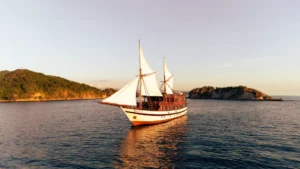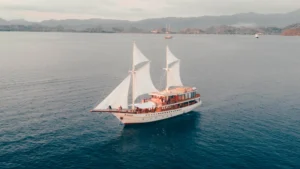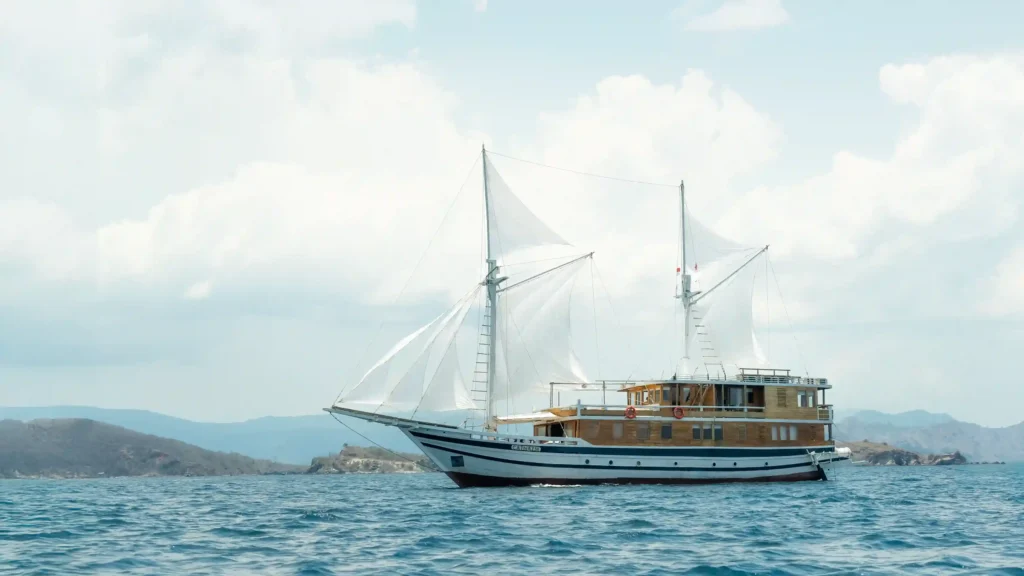
A sailing cruise in Komodo runs on two seasonal engines: the dry southeast trade winds from roughly April to November, and the wet northwest monsoon from December to March. Book inside the dry window and you get calm anchorages and 15–30 meter water clarity; book the monsoon and you trade comfort for plankton-rich seas and peak manta activity.
The honest part first: phinisi mostly motor-sail
The two-masted phinisi is a genuine sailing hull, but inside the park most boats run on engine with sails raised for stability, photography and the occasional favorable reach. Distances between anchorages are short and schedules are stop-dense, so pure sailing passages are rare on standard itineraries. If wind-in-canvas time matters to you, say so when booking — longer crossings (Labuan Bajo to the park’s west, or the Bali route) offer real sailing legs that the standard loop does not.
How the wind calendar shapes your trip
| Months | Wind pattern | Sea state | Trip implications |
|---|---|---|---|
| Apr–Jun | Trades building | Calm | Best all-around window |
| Jul–Aug | SE trades peak | Calm anchorages, chop on open crossings | Clearest water, busiest season |
| Sep–Nov | Trades easing | Calm | Great value, fewer boats |
| Dec–Mar | NW monsoon | Roughest of the year | Sheltered central routes, manta peak |
Operators plan around this calendar in ways worth knowing: long Bali–Komodo transits concentrate in April–October, and some boats go into maintenance or stay local during December–March rather than fight monsoon crossings.
Route logic on a sailing itinerary
The classic multi-day route works with the park’s geography rather than against it. Boats head southwest on day one toward Rinca or Kelor, anchor near Kalong Island for the sunset bat exodus, position overnight for a dawn climb at Padar, then work the central snorkel belt — Pink Beach, Karang Makassar, Taka Makassar, Siaba — before a final morning leg home. Night repositioning is the whole trick: the hull earns its keep while you sleep. Our Komodo overnight cruise page explains the standard 2D1N version of this rhythm.
Choosing a hull that matches the season
In the dry season, almost any well-maintained phinisi delivers a comfortable trip. In the shoulder and wet months, size and displacement matter: a heavier hull rides chop better, covered decks stay usable in rain, and experienced captains re-sequence stops around wind windows. Compare specific vessels — length, build year, cabin count, crew size — on our phinisi charter fleet comparison before you fall for deck photos.
What a sailing day actually feels like
- 05:30–06:30: anchor up, coffee on deck, short passage to the morning landing.
- Morning: the day’s hike or trek before the heat builds.
- Midday: passage under way; lunch served while the boat moves.
- Afternoon: two or three water stops as the light softens.
- Dusk: anchor set, bats overhead if you are near Kalong, dinner at anchor.
It is an unhurried format that rewards travelers who want the sea to be the point, not just the transport. For deeper multi-night route variations beyond the standard loop, the Labuan Bajo liveaboard specialists at LabuanBajoLiveaboard.com maintain the most complete route library in the region. To sanity-check a specific boat or month, message us on WhatsApp at +62 811 3823 875.
Quick answers on sailing conditions
Will the boat actually sail, or just motor?
Expect motor-sailing on standard park loops: distances are short, anchorages are fixed, and schedules leave little room for tacking. Sails go up for stability and for the long open legs — the western approaches and the Bali crossing are where phinisi genuinely sail. If canvas time is the point of your trip, book the longer routes and tell the operator explicitly.
How rough does it really get in the monsoon?
Inside the central park, December–March mostly means afternoon squalls, grey passages and re-sequenced stops rather than drama — the islands themselves shelter the main anchorages. The open crossings are a different matter: the Lombok Strait and the park’s exposed southern edges earn their reputation in the northwest monsoon, which is why operators concentrate long transits in April–October.
Do sailing trips get seasick passengers?
Fewer than newcomers fear. The standard loops run in protected water with nights at anchor, and most guests acclimatize within hours. Sensitive travelers should take their preferred remedy before the first leg, choose a mid-ship lower cabin, and keep eyes on the horizon during passages — the standard toolkit handles the standard conditions.