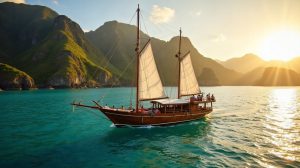
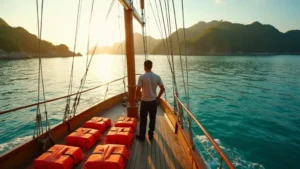
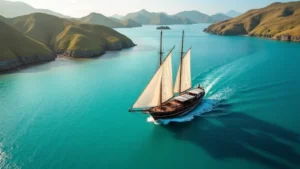
A sustainable Komodo cruise rests on three decisions made before you step aboard: paying the park’s conservation fees willingly, booking within the visitor-management rules that now shape access to Komodo National Park, and choosing an operator that genuinely follows regulations on anchoring, wildlife distance, and waste. Everything else — reef-safe sunscreen, a refillable bottle, respectful conduct on a dragon trek — builds on those three choices.
This guide is for travellers planning a 2027 sailing who want their trip to support the park rather than strain it. It complements our breakdown of Komodo National Park fees and visitor limits with the practical side: what you can personally do, and what you should demand from your boat.
Where Your Conservation Fee Actually Goes
Komodo National Park is a UNESCO World Heritage Site, and the entrance and conservation fees — usually settled separately from your cruise fare, in cash at the gateway or added to your operator’s invoice — fund the work that keeps the park worth visiting:
- Ranger patrols. Rangers escort every dragon trek on Komodo and Rinca, and patrol against illegal fishing, poaching, and unauthorised landings across the marine reserve. Trekking with a ranger is mandatory, and fees keep that system staffed.
- Komodo dragon monitoring. The dragons survive in the wild only here. Population monitoring, habitat management, and research depend on park revenue.
- Reef protection. Manta Point, Taka Makassar, and the reefs off Pink Beach sit inside the protected zone. Mooring infrastructure and marine patrols draw from the same pool.
Fee amounts are periodically revised, so treat any figure you read online as indicative and verify the current schedule close to departure. A reputable operator states clearly which fees are included and which are payable on entry — ambiguity here is a warning sign.
Visitor Limits: Why Quotas Make Advance Booking Essential in 2027
Park authorities have progressively tightened how visits are managed — registration requirements, managed daily capacity at sensitive sites, and periodic reviews of how many guests the trails and reefs can absorb. The mechanics keep evolving, which is exactly why they matter for planning.
The consequence is simple: access is no longer effectively unlimited. When capacity at Padar Island or the trekking trails is managed, boats need confirmed slots, and slots go to advance bookings. For 2027 this changes the calculus in three ways:
- Peak season fills first. July and August were always busy; under managed capacity, late bookers risk itinerary substitutions, not just crowded viewpoints.
- Shared departures become firmer commitments. An open-trip boat carrying 8–22 guests cannot easily re-shuffle its permits.
- Compliance shows early. An operator promising “we can always get you in” regardless of quotas is telling you how it treats every other rule too.
Booking three to six months ahead for high season is no longer just a price strategy — it is how you guarantee the itinerary you were sold is the one you sail.
Responsible Practice On Board
Sustainability on a Komodo cruise is mostly a set of small, verifiable behaviours — yours and the crew’s.
Reef-safe sunscreen
Sunscreens containing oxybenzone and octinoxate are associated with coral stress. Bring a mineral-based, reef-safe product from home — supply in Labuan Bajo is inconsistent — and apply it well before entering the water. A rash guard reduces how much you need at all.
No anchoring on coral
Anchor damage is one of the most direct harms a cruise can inflict. Responsible captains use mooring buoys where available, anchor only over sand, and refuse to drop anchor on reef even when it costs time. A captain who anchors onto coral at a snorkelling site is making an operator decision, not having bad luck.
Distance from wildlife
Follow your ranger’s instructions without negotiation: keep the required distance, stay in the group, never bait or provoke a dragon for a photo. The same logic applies to manta rays at Manta Point — encounters are conditions-dependent, and the correct behaviour is to hold position calmly and let the animals set the distance. Chasing or touching them is prohibited under park rules.
Zero single-use plastic
The better boats in the fleet have moved decisively away from single-use plastic: refill stations instead of bottled water, waste separation, nothing discharged at sea. That standard is now common on well-run luxury Komodo cruise vessels, where refill systems and closed waste handling are part of the product rather than a marketing line. Bring your own bottle regardless of tier.
How to Choose a Park-Compliant Operator
You cannot audit a boat from your living room, but five questions before paying a deposit separate compliant operators from the rest:
- How are park fees handled? A clear answer — which fees, paid where, included or excluded — signals an operator working with the park, not around it.
- Where do you moor at Pink Beach and Manta Point? Listen for buoys and sand, not evasion.
- What happens to waste during a 3D2N sailing? The right answer involves storage on board and disposal back in Labuan Bajo.
- How are ranger arrangements made? Every legitimate itinerary includes ranger-escorted trekking; vagueness here is vagueness about the law.
- Is there a proper briefing? A boat that runs a conduct and safety briefing before the first landing takes rules seriously.
Established fleet operators are generally easier to verify than one-boat outfits with no track record. Komodo Luxury, the operator behind much of the fleet we work with, publishes a detailed destination guide to Komodo National Park — how an operator talks about the park tells you a great deal about how it behaves inside it.
Shared or Private: Does Format Change Your Footprint?
Neither format is inherently greener — execution decides. A shared boat spreads fuel and mooring impact across more guests per sailing, a genuine efficiency; browse current Komodo open trip cruise departures if that model suits you. A private phinisi concentrates the impact on one group but gives you control: you choose the operator, the pace, and the on-board standards, and can specify sustainable practice at booking. Pricing for both formats varies by season and vessel tier, so treat published rates as indicative starting points and confirm on request.
What to Do If You Witness a Violation
Even careful travellers occasionally see things that should not happen — a boat anchoring on reef, a guide baiting a dragon, garbage over the side. Respond in this order:
- Raise it with the crew immediately and calmly. Most violations stop when a paying guest names them. Speak to the captain, not just a deckhand.
- Document. A photo with time and location outweighs an argument. Note the vessel name if it is not your own boat.
- Report to the rangers. Posts on Komodo, Rinca, and Padar are the park’s enforcement arm, and documented visitor reports carry weight.
- Report to your booking agent, and say it in your review. Agencies drop operators with credible complaints; honest reviews are the market’s strongest compliance mechanism.
Do not physically intervene in wildlife situations or confront another vessel’s crew at sea — document and report instead.
Frequently Asked Questions
Are Komodo National Park conservation fees included in my cruise price?
Usually not. Most operators treat entrance, ranger, and activity fees as a separate item paid in cash on entry or added to your invoice. Confirm the arrangement in writing before booking, and treat online fee figures as indicative until verified.
Do visitor quotas mean I could be refused entry?
With a compliant operator that has confirmed your itinerary against current registration and capacity rules, refusal is very unlikely. The real risk sits with last-minute peak-season bookings, when managed capacity can force itinerary changes. Booking well ahead for July–August 2027 is the reliable protection.
What sunscreen should I bring?
A mineral-based, reef-safe sunscreen free of oxybenzone and octinoxate, bought before you travel, combined with a rash guard so you need less product in the water.
Is a private charter less sustainable than an open trip?
Not necessarily. Shared departures are more fuel-efficient per guest, but a private charter lets you choose a rigorously compliant operator and set the standards on board. Practices matter more than format.
Can I visit the dragons without a ranger?
No. Ranger-escorted trekking is mandatory on Komodo and Rinca, for your safety and the dragons’ protection. Any operator suggesting otherwise is proposing a violation, not a shortcut.
Plan a Responsible 2027 Komodo Cruise
Sailing sustainably in Komodo is not complicated: pay the fees, book within the rules, and choose a boat that treats the park as its future rather than its inventory. For help matching your dates to a compliant vessel — shared departure or private phinisi — message us on WhatsApp at +62 811 3823 875 or email [email protected] with your travel window and group size, and we will recommend boats whose practices we can vouch for.