Komodo Cruise FAQ 2027: 100 Answers on Open Trips, Private Phinisi & Prices
This page answers the 100 questions travellers ask most often before booking a Komodo cruise from Labuan Bajo — open trip versus private phinisi, real prices, park fees, seasons, safety and what actually happens on board. It is written for first-time visitors and returning divers who want figures and rules, not marketing. Answers were compiled by the Komodo Cruise team from official park and immigration sources, operator quotes and our own sailing seasons in Komodo National Park. Reviewed for 2027.
Open trip vs private phinisi
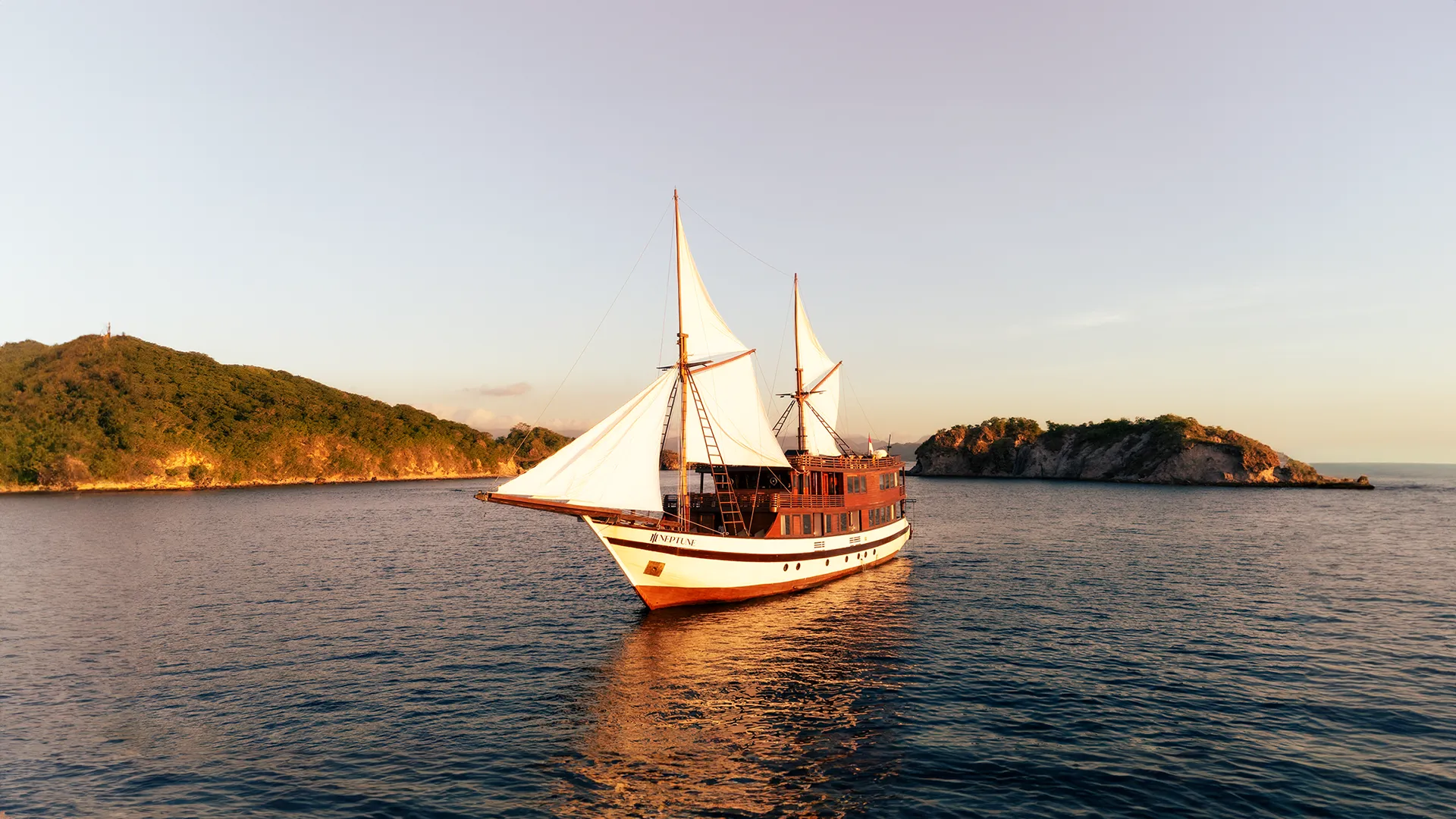
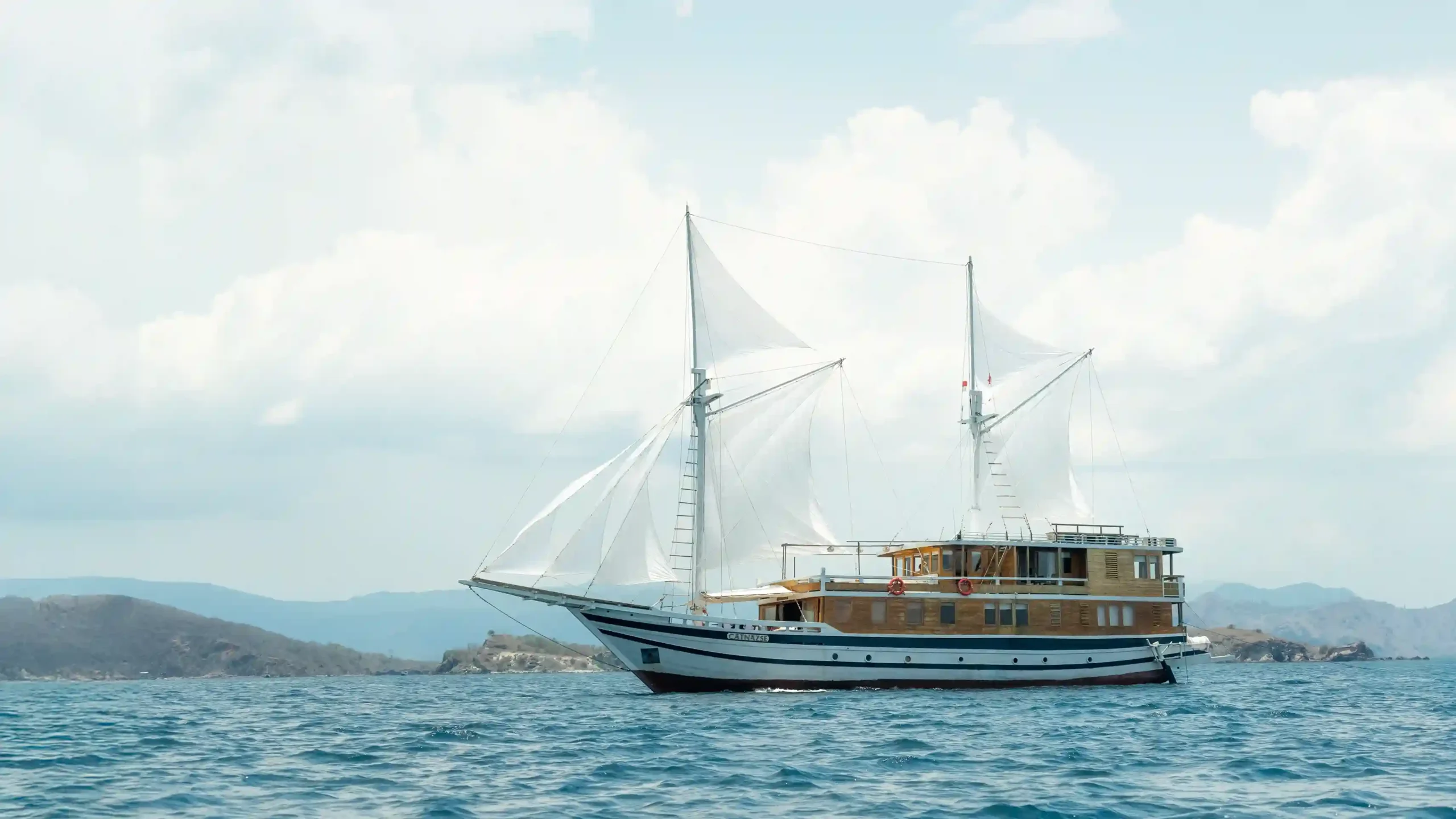
Every Komodo cruise from Labuan Bajo is sold in one of two ways: per person on a shared departure, or per boat per night as a private charter. The vessels come from the same pool of wooden phinisi, speedboats and yachts, including the fleet classes listed by our operating partner at komodoluxury.com.
What is the real difference between a Komodo open trip and a private phinisi charter from Labuan Bajo?
A Komodo open trip sells you one bed or one cabin on a scheduled phinisi leaving Labuan Bajo that follows a fixed route shared with other travellers, while a private charter gives your group the entire boat, the full crew and a customisable itinerary. Open trips are priced per person; private charters are priced per boat per night. Both depart from Labuan Bajo harbour and cover the same core Komodo National Park sites.
Is an open trip really much cheaper than renting a private phinisi in Komodo?
Shared open trips typically start from around IDR 1,200,000 to 2,800,000 per person for 3D2N, while private phinisi are chartered per boat per night, commonly from USD 1,800 to 2,400 for budget vessels and USD 2,500 to 4,000 for standard ones. All figures are indicative market bands that move with season, boat class and fuel. Ask for a written quote before you commit.
For a couple, which is better value: an open trip or a small private phinisi?
For two people a Komodo open trip is almost always cheaper per person than a private phinisi, because a charter bills the whole boat regardless of headcount. A couple joining a mid-range shared phinisi pays an indicative USD 280 to 450 each for 3D2N, while even a budget private boat starts near USD 1,800 per night. Couples wanting privacy usually upgrade to a private cabin on a shared boat. Rates are confirmed on request.
We are eight friends, so does a private Komodo phinisi work out cheaper than eight open-trip seats?
Once a private Komodo phinisi is split across eight to ten guests, the per-person cost often lands close to or below a mid-range open trip. A standard private phinisi at an indicative USD 2,500 to 4,000 per night divided by eight can rival a USD 350 to 450 per-person shared cabin, while also giving you your own itinerary. Ask for a per-boat quote with fuel and crew stated in writing.
What is a join-in cabin trip and how does it differ from a normal open trip?
A join-in cabin trip on a Komodo cruise sells individual cabins on a boat that is normally chartered privately, so you share the vessel with fewer people, often eight to fourteen guests rather than up to twenty-two, and get charter-grade facilities. Cabins are usually en-suite with air conditioning. It sits between a budget open trip and a full private charter in both comfort and price.
How many guests are usually on a shared Komodo open trip?
Shared phinisi in Komodo typically carry eight to twenty-two guests, depending on the vessel’s cabin count and class. Budget wooden boats pack more people into dorm-style or fan cabins, while luxury shared phinisi cap numbers lower to protect space on deck and at meal times. Ask the operator for the maximum guest number and the cabin plan before you pay a deposit.
Can I book a private day-use phinisi instead of joining a group boat?
Several Labuan Bajo operators sell private day-use phinisi and speedboats for a single day on the water. Private speedboat day charters run an indicative IDR 10,000,000 to 25,000,000 per boat, roughly USD 650 to 1,600, and suit families who want their own schedule at Padar and Pink Beach. Pricing is on request and depends on boat size and routing, so send your dates for a firm quote.
Are open trips too party-oriented for couples who want a quiet cruise?
Budget Komodo open trips carrying up to twenty-two guests can be social and lively because they attract younger travellers sharing dorm-style cabins, while mid-range and luxury shared phinisi are noticeably quieter and skew toward couples and families. If atmosphere matters, ask the operator about the typical guest profile, whether alcohol is sold on board, and whether the boat has upper-deck or bow seating away from the main group.
Can I charter a modern yacht or catamaran instead of a traditional wooden phinisi?
A small number of modern motor yachts and catamarans operate in Komodo National Park, but they are far fewer than traditional wooden phinisi and cost more. Indicative rates run USD 3,500 to 6,000 per night for a standard luxury yacht and USD 6,000 to 12,000 for premium vessels, with superyachts higher again. Availability is limited, so enquire early with your dates and expect an on-request quote.
Which cruise format suits solo travellers best?
Solo travellers get the best value from a Komodo open trip out of Labuan Bajo, where you buy one bed or one cabin on a fixed departure instead of chartering the whole boat. True single cabins are limited and usually carry a supplement approaching the price of two people. Many operators will instead pair you with a same-gender cabin mate at no surcharge, so confirm which policy applies to your chosen vessel in writing.
Prices, inclusions and hidden costs
Every figure below is an indicative market band for the 2026 to 2027 seasons. Komodo pricing moves with fuel, exchange rates, boat class and departure date, so treat these numbers as a planning range and confirm your own quote in writing.
How much does a budget Komodo open trip 3D2N cost per person?
Budget open trips for 3D2N are commonly advertised from IDR 1,200,000 to 2,000,000 per person, an indicative USD 150 to 300. That tier means fan cabins or dorm berths, shared bathrooms and simple meals, and it usually excludes Komodo National Park fees. Prices move with season and fuel, so treat any figure as a starting point and request a current written quote.
What is the price range for a mid-range air-conditioned cabin on a 3D2N open trip?
Mid-range shared phinisi with air-conditioned cabins commonly sit around IDR 1,800,000 to 2,800,000 per person, or an indicative USD 280 to 450 for 3D2N. That tier normally brings a private twin or double cabin, better food and a larger sun deck. Luxury shared phinisi run higher, roughly USD 450 to 850 per person. Final rates depend on departure date and cabin position, so ask for confirmation.
How much does it cost to charter a private phinisi for 3D2N?
Entry-level private phinisi charters start from an indicative IDR 36,000,000 for the whole boat for 3D2N, with 2D1N benchmarks near IDR 40,500,000 on larger vessels. Per-night charter bands run USD 1,800 to 2,400 for budget boats, USD 2,500 to 4,000 for standard and USD 4,500 to 8,000 for premium. Every charter is quoted on request based on dates, guest numbers and routing.
What do luxury private Komodo phinisi and yachts cost per night?
Premium phinisi charters are indicatively USD 4,500 to 8,000 per night, standard luxury yachts USD 3,500 to 6,000, and premium yachts USD 6,000 to 12,000. Superyacht and VIP vessels start from USD 8,000 to 15,000 per night, with ultra-luxury programmes quoted higher again. These are market bands rather than fixed prices, and each vessel is quoted on request for your specific dates.
What is normally included in a Komodo open trip package?
A standard open trip includes your cabin or berth, all meals on board, drinking water plus tea and coffee, basic snorkelling equipment, a local guide and crew, and usually harbour transfers within central Labuan Bajo. Komodo National Park entrance and ranger fees, alcoholic drinks, gear upgrades and crew tips are typically excluded. Always request the inclusion list in writing before paying a deposit.
What is included in a private phinisi charter price?
A private Komodo phinisi charter normally covers exclusive use of the boat and all cabins, the full crew including captain, chef, deckhands and guide, all meals and non-alcoholic drinks, snorkelling gear, and standard fuel for the agreed routing. Higher tiers add en-suite cabins, dive facilities, kayaks or paddleboards and premium dining. Park fees, alcohol and routing beyond the agreed fuel allowance are usually charged separately.
Are Komodo National Park entrance fees included in the cruise price?
Park entrance and ranger fees are excluded from most Komodo cruise prices and are paid separately, either in cash at the park gate or added to your invoice. Some mid-range and premium packages do bundle them in. Because Indonesian park fee structures have been revised several times, ask which fees apply to your exact departure date and nationality rather than assuming.
Roughly how much are Komodo National Park fees per person for a 3D2N cruise?
Park-related fees for a 3D2N cruise commonly add an indicative IDR 500,000 to 1,500,000 per person, varying by nationality, weekday versus weekend, and which activities such as trekking, snorkelling or diving you join. Fee schedules are set by the authorities and have changed more than once. Confirm the current amount with your operator before departure instead of budgeting from an older figure.
What hidden fees catch travellers out on Komodo cruises?
The most common extras are Komodo National Park and ranger fees, snorkelling or diving gear rental, drone permissions, alcoholic drinks, harbour taxes and crew tips. Fuel surcharges also appear on private charters when you request routing beyond the agreed plan. Insist on a written breakdown that states explicitly whether fuel, park fees and harbour taxes are included or excluded from the headline price.
How much extra should I budget per day for drinks, tips and rentals?
Many travellers spend an indicative IDR 150,000 to 400,000 per day on soft drinks, beer, gear rental and small extras, which varies widely by boat and by drinking habits. Budget boats sell drinks cheaply while luxury phinisi charge resort-style prices. Because there is no card payment at sea, carry that amount in rupiah cash for the full length of your cruise.
How much should I tip the crew on a 3D2N Komodo cruise?
Tipping is discretionary, and many guests give an indicative IDR 150,000 to 300,000 per person for a 3D2N cruise, placed in a shared crew box on the final morning. Larger private charters often tip as a group instead. There is no fixed rule and crews do not expect a tip where service fell short. Bring the amount in rupiah cash, since cards are not accepted on board.
Are Komodo cruise prices negotiable in Labuan Bajo?
Prices are often negotiable when you book in person in Labuan Bajo, especially for budget and mid-range boats outside the June to September peak. Discounts are far rarer for luxury phinisi and for private charters with fixed crew costs. Bargaining a headline price down while extras stay hidden is a false saving, so compare written inclusion lists rather than the number alone.
Best time and seasons
What is the best month for a Komodo cruise with calm seas?
April to November is the main calm-water season for Komodo cruises from Labuan Bajo, and June to September usually delivers the best underwater visibility. July to September are the driest months, with the clearest skies for Padar. December to March is the rainy and windy period, when departures are cancelled more often and crossings feel noticeably rougher.
Is it a mistake to cruise Komodo in January?
January falls in Komodo’s rainy and windy season, when trips are cancelled more frequently and the crossings from Labuan Bajo can be rough. Boats still sail, prices soften and the islands turn green, but you should build a spare day into your plans and accept that Manta Point or a Padar climb may be dropped for safety reasons.
When is manta season at Manta Point?
Mantas are encountered at Manta Point in Komodo National Park year-round, with sightings usually strongest through the rainy and transitional months of roughly December to March, when plankton levels rise. No operator can guarantee an encounter, because captains only stop when current and visibility allow. If mantas are your priority, say so at booking so your itinerary can be built around the better tidal windows.
When is the driest time to hike Padar Island?
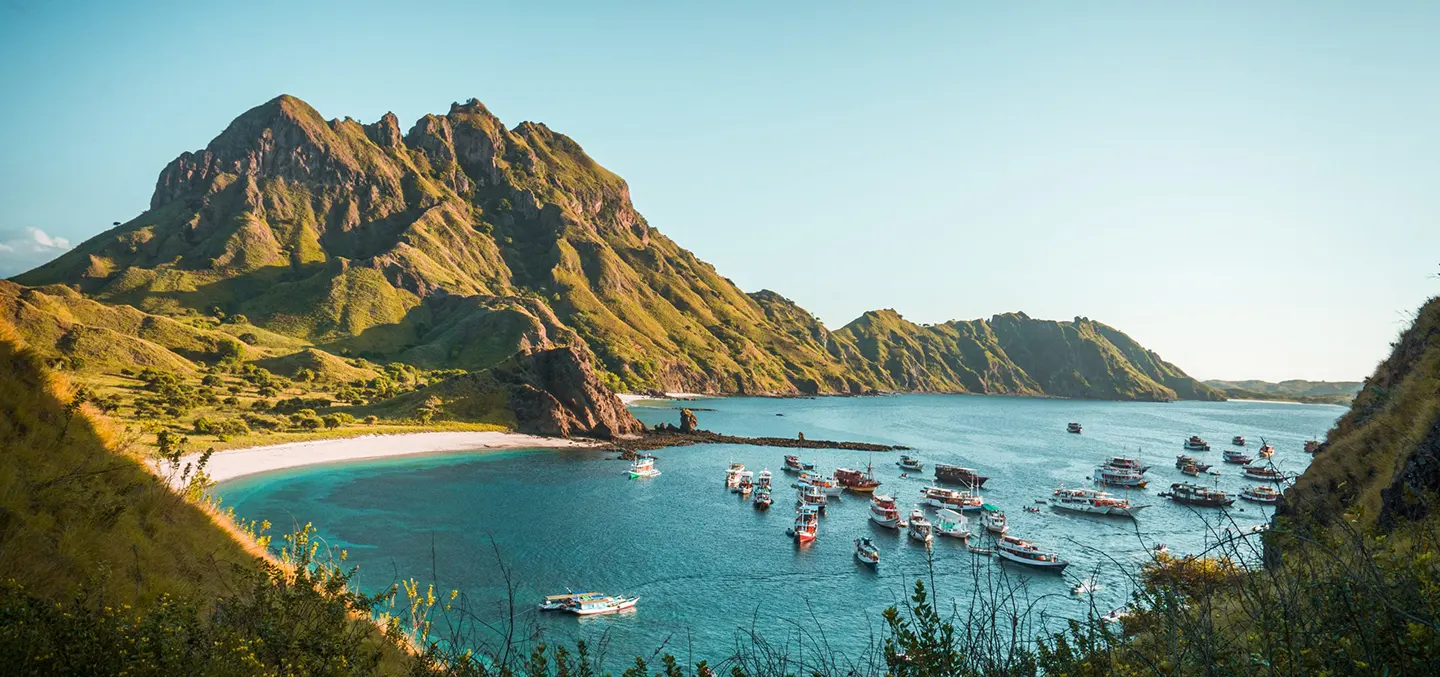
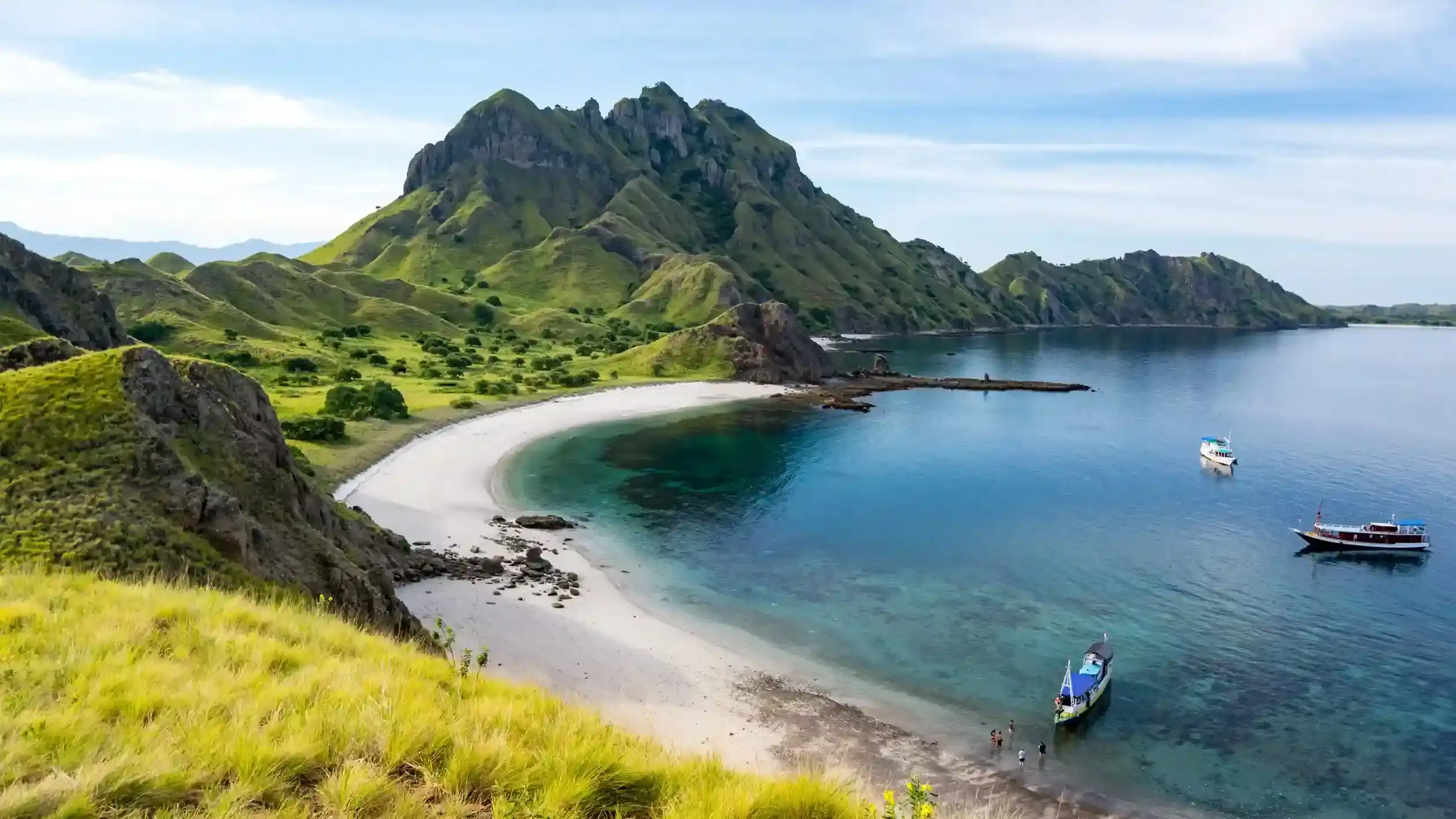
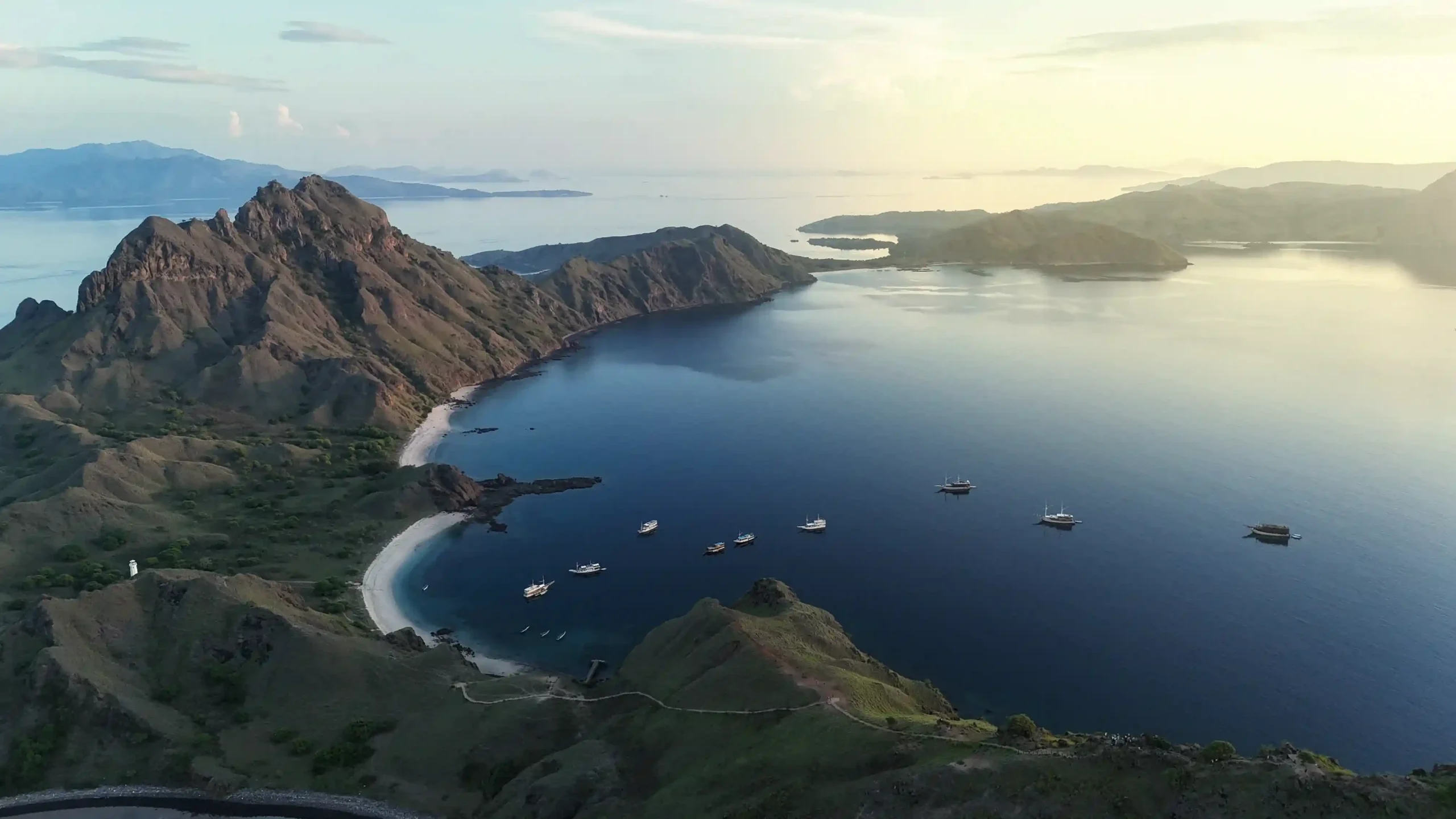
July to September are typically Padar’s driest months, when the hills turn golden-brown and skies are clearest for the classic three-bay viewpoint photograph. The trail is fully exposed with no shade, so cruises climb at sunrise or late afternoon. During the rainy season the same slopes are green and the stepped path becomes slippery underfoot.
When does Pink Beach look most vibrant?
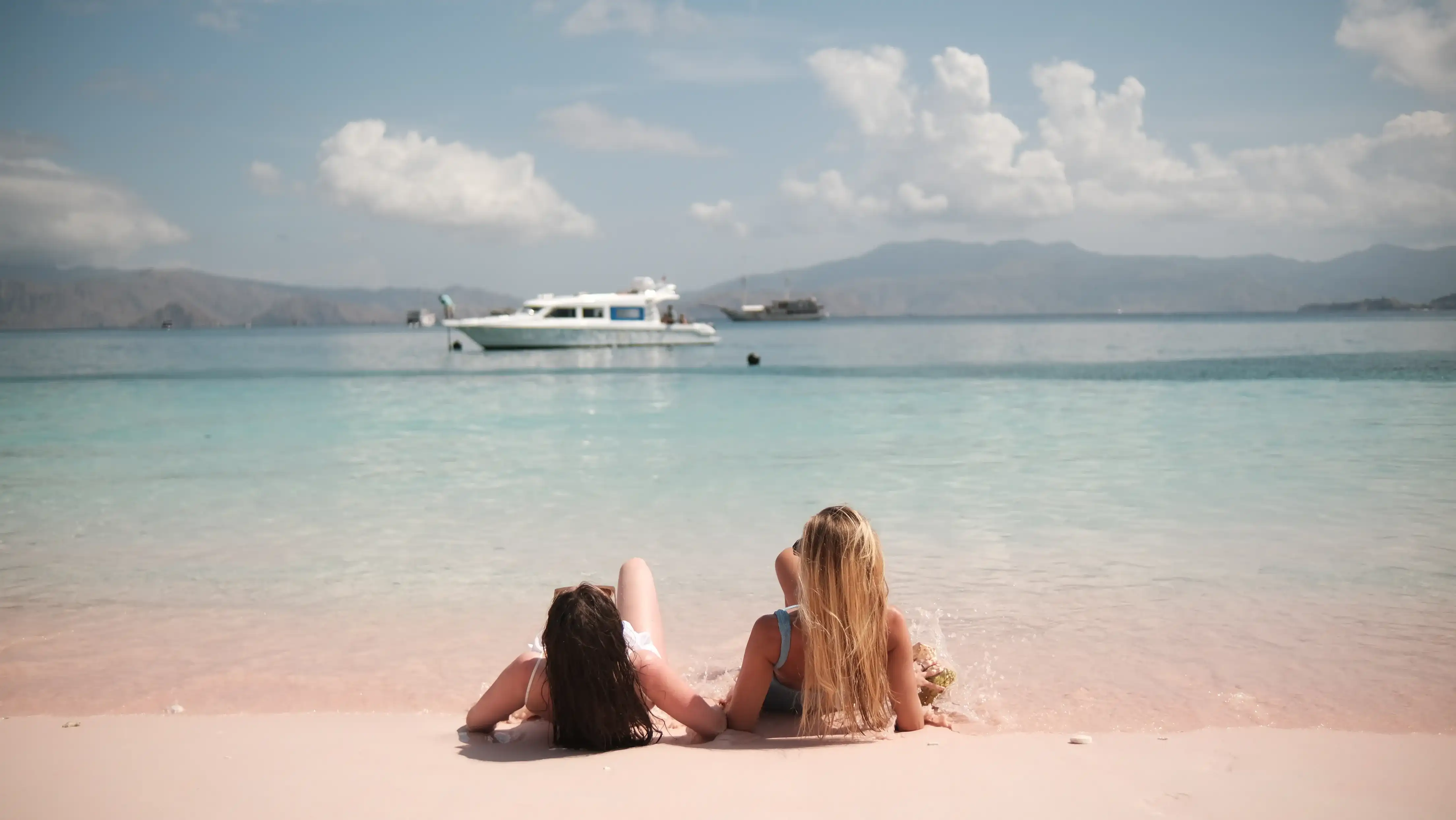
Pink Beach shows its rose tint year-round, because the colour comes from crushed red organ-pipe coral mixed into white sand rather than from any season. It reads strongest under bright dry-season sun between roughly May and October, and when fewer boats have stirred the shallows. Early morning and late afternoon stops give the best colour with the fewest crowds.
Is August too crowded to enjoy a Komodo cruise?
August is peak season in Komodo National Park, so Padar’s viewpoint, Pink Beach and Manta Point see the heaviest boat traffic of the year. Cruises still run well, but you should book months ahead, expect queues on the Padar steps, and favour operators who deliberately arrive early or late at the main sites to sidestep the crowd.
Will I still see Komodo dragons if I cruise in March?
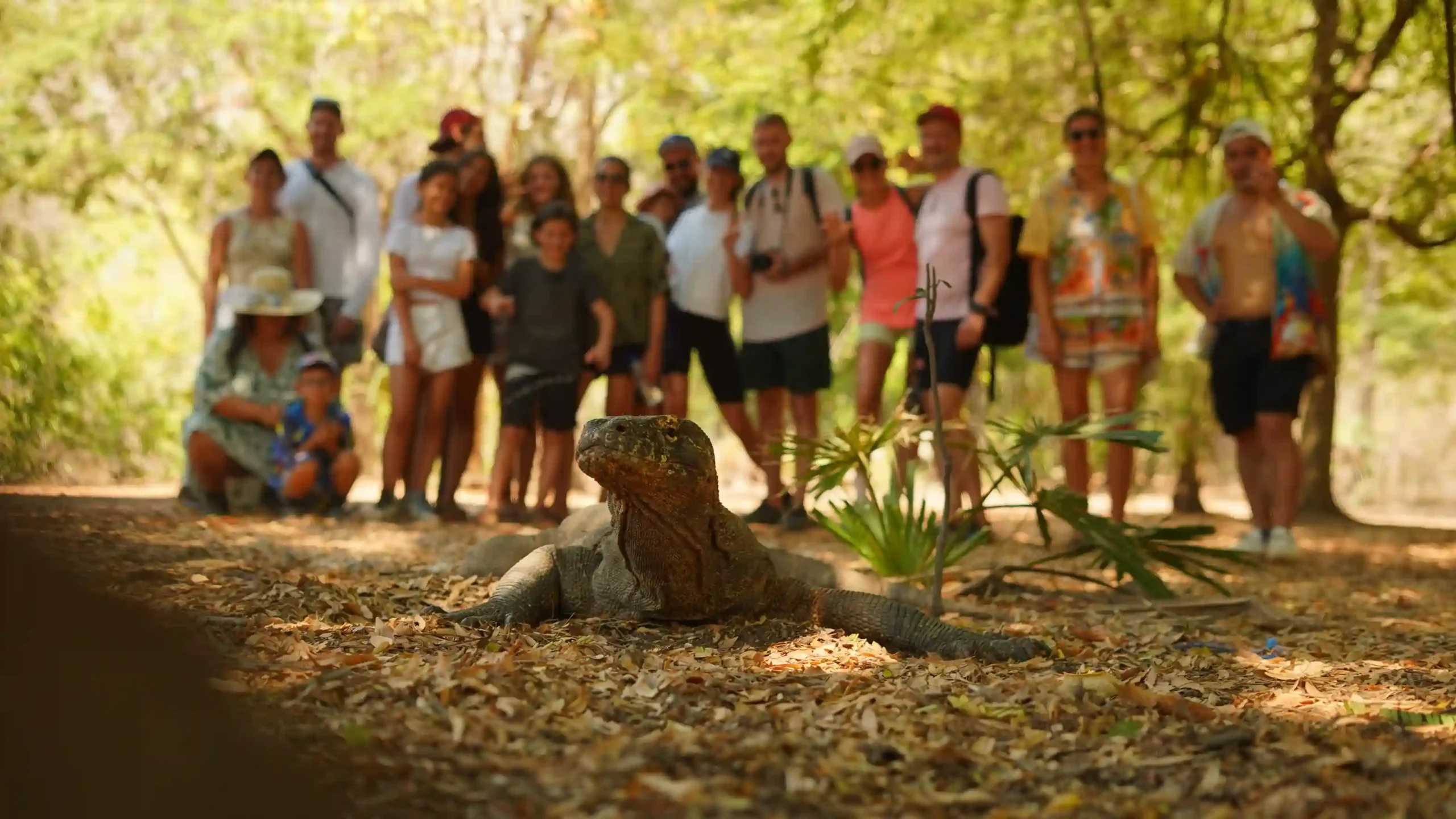
Komodo dragons are seen year-round on Komodo and Rinca islands, including in March, because they are resident wild animals rather than seasonal visitors. Rangers know their usual feeding and nesting areas so encounters are common, but no sighting is ever guaranteed. Dragons are typically less active during the hottest hours in the middle of the day.
Do cruises run during Ramadan, and does service change?
Komodo cruises operate normally throughout Ramadan, with departures from Labuan Bajo unchanged. Some Indonesian crew members fast during daylight hours, but guest meals are still prepared and served as usual. If you would like to be considerate, ask your operator in advance whether the crew is fasting and keep music and alcohol discreet during daylight hours.
How rough are the seas in the wet season and is seasickness common?
Crossings between Labuan Bajo and Komodo can be choppy from December to March and during the transitional months, and seasickness is common on smaller wooden boats. Larger phinisi ride swell more comfortably, and lower-deck cabins near the middle of the boat move least. Take medication before boarding rather than after symptoms start, and watch the horizon from the deck.
Itineraries and trip length
Is a one-day Komodo speedboat trip from Labuan Bajo enough?
A one-day speedboat trip covers two or three highlights, usually Padar, Pink Beach and either Komodo or Rinca for dragons, in a long day that starts around 6am. It works if your time in Labuan Bajo is short, but it is rushed and leaves little water time. A 2D1N or 3D2N cruise gives a far fuller experience of the park.
Is a 2D1N cruise worth it, or should I stretch to 3D2N?
3D2N is the most in-demand Komodo format because it adds a Padar sunrise, a second full snorkelling day and a much less rushed schedule. A 2D1N cruise still delivers Padar, a dragon trek, Pink Beach and Manta Point in compressed form. If your flights allow only one extra night, 2D1N remains a solid compromise rather than a poor one.
What is the standard 3D2N Komodo itinerary?
A standard 3D2N loop from Labuan Bajo covers Padar Island for sunrise or sunset, Komodo or Rinca for a ranger-led dragon trek, Pink Beach for snorkelling, Manta Point for manta encounters, the Taka Makassar sandbank, and Kanawa or Kelor for a final swim. Many boats add the Kalong mangroves at sunset for flying foxes and Siaba for turtles.
What does a 2D1N Komodo itinerary usually cover?
A typical 2D1N runs Kelor or Kanawa for a first snorkel, then Padar at sunset and an overnight anchorage, followed on day two by a Komodo or Rinca dragon trek, Pink Beach, Manta Point and Taka Makassar before returning to Labuan Bajo. Site order shifts with tides, and the sunrise Padar climb is normally traded for a sunset one.
What extra sites does a 4D3N or longer liveaboard add?
Longer 4D3N and five-day liveaboards keep the Padar, Komodo, Pink Beach and Manta Point core, then add northern or central sites such as Kanawa, Sebayur, Siaba and Gili Lawa plus extra reef stops and more relaxed anchorage time. The extra nights mostly buy dive and snorkel volume and quieter arrivals at popular spots rather than dramatically different scenery.
What time do boats leave Labuan Bajo?
Day trips normally depart Labuan Bajo harbour between 6am and 7am to reach the park before the heat and the crowds. Multi-day open trips usually board in the late morning or early afternoon, which suits guests arriving on a morning flight. Your operator confirms the exact boarding time and meeting point the day before departure.
What time does a 3D2N cruise return to Labuan Bajo?
Most 3D2N cruises dock back in Labuan Bajo on the afternoon of day three, commonly between 2pm and 4pm, after a final snorkel stop at Kanawa or Kelor. Return times shift with weather and sea conditions, so treat the schedule as indicative and avoid booking anything tight for that same afternoon.
Is the Padar sunrise worth a 3am wake-up?
Padar Island’s sunrise viewpoint is the stop most Komodo cruise guests put first, which is why boats wake guests between 3am and 4:30am to tender ashore and climb before first light. The main viewpoint is a stepped climb of roughly 20 to 30 minutes. Cloud can obscure the view, so no operator guarantees conditions.
Should I visit both Komodo Island and Rinca, or is one enough?
One dragon-trekking island is enough for most visitors to Komodo National Park, and choosing either Komodo or Rinca saves both time and a second set of ranger fees. Komodo Island feels more iconic and offers longer trail options, while Rinca is closer to Labuan Bajo and often less crowded. Both use compulsory ranger-guided walks with reliable dragon sightings.
Can I combine a Komodo cruise with a Flores overland tour?
Many travellers pair a Komodo cruise with an overland Flores route to Wae Rebo village or the Kelimutu crater lakes, starting or finishing in Labuan Bajo. These are usually arranged as separate bookings and need at least three extra days because of long mountain drives. Tell your cruise operator your onward plan so the departure days line up.
Booking, payment and logistics
Do I need to book before arriving in Labuan Bajo?
Advance booking is strongly recommended for June to September and for Indonesian holiday periods, when the better boats sell out weeks ahead. In the low season you can often still find last-minute open-trip spots in town within a day or two. Private phinisi for specific dates frequently sell out months in advance, so plan those early.
How far ahead should I book a private phinisi?
Popular private phinisi are commonly booked out months ahead, particularly for July and August and for Christmas and New Year sailings. If you need specific dates, a specific vessel or a specific cabin configuration, enquire as soon as your flights are fixed. Shoulder-season charters are easier to secure and are where flexible dates buy the most value.
Can I fly into Labuan Bajo and start a cruise the same day?
Boarding a multi-day cruise on the same day as a morning arrival into Labuan Bajo is common, because most open trips depart late morning or early afternoon. The risk is flight delays, which are frequent on the Bali to Labuan Bajo route. Arriving the night before removes that risk entirely and is what most operators recommend.
Is it safe to fly out the same afternoon my cruise ends?
Booking a flight for the same afternoon your cruise docks is risky, because return times of 2pm to 4pm shift with weather and sea state. An evening departure gives a workable buffer and a night in Labuan Bajo is safer still. Never plan an international connection out of Bali on the day your boat returns.
Can I book directly with boat operators rather than through an agent?
Most Komodo boats can be booked directly online or over WhatsApp, which removes an agency margin and a layer of miscommunication. Local agents earn their place when you want hotels, transfers and a Flores extension bundled together. Either way, insist on a written itinerary, an inclusion list and confirmation of the exact vessel name.
Is booking online safer than booking in person in Labuan Bajo?
Booking a Komodo cruise online with an established operator gives you a digital paper trail of quote, itinerary, inclusion list and payment record, which matters if a boat is downgraded or a trip is cancelled. Vetted local agencies can be equally reliable and sometimes cheaper. The real safeguard is documentation, not the channel you happen to book through.
Can I inspect the boat before paying in full?
Many operators will let you view the phinisi in Labuan Bajo harbour, or send dated photos and video of the actual vessel, before the balance falls due. Ask for the specific boat name rather than a class label, since a deluxe phinisi description means different things to different agents. A refusal to name the vessel is a warning sign.
Do Komodo cruise operators accept credit cards?
Bank transfer is the dominant payment method for Komodo cruises, usually a deposit at booking and the balance before departure. Some larger operators accept cards, often with a surcharge, while smaller agencies remain cash-heavy. Park fees and onboard extras are almost always cash in Indonesian rupiah, so never rely on card access once you leave port.
Do cruises include hotel pickup in Labuan Bajo?
Most organised Komodo cruises include transfers between central Labuan Bajo hotels and the harbour, and many also cover airport pickup on request. Hotels outside the town centre or up the hillside may fall outside the free transfer zone. Confirm your pickup point and time in writing the day before, and share your hotel name at booking.
Boats, cabins and facilities
What are the main classes of Komodo boats?
Komodo boats fall into three broad classes: budget wooden boats with fan cabins or dorm berths and shared bathrooms; mid-range phinisi with air-conditioned private cabins and some en-suites; and luxury or VVIP phinisi and yachts with spacious en-suite cabins, professional crew and premium dining. Speedboats form a separate category used for fast day trips rather than overnight cruising.
What amenities should I expect on a mid-range Komodo phinisi?
A mid-range Komodo phinisi normally provides air-conditioned private twin or double cabins, some with en-suite bathrooms, a shaded dining area, a sun deck and freshwater showers that may or may not be heated. Power outlets are standard but not always available around the clock. Specifications differ boat to boat, so ask for the deck plan and current cabin photos.
Are open-trip cabins mixed dorms or private rooms?
Most mid-range and higher Komodo open trips use private twin or double cabins, while budget wooden boats may sell dorm-style or shared berths in a mixed-gender layout. Cabin type is the single biggest driver of open-trip price. If sharing with strangers is unacceptable, book a private cabin tier and have the cabin category written into your booking confirmation.
Can I get a single cabin, and what is the solo supplement?
Single-occupancy cabins are limited on Komodo boats, and where they exist the supplement often approaches the price of a second guest because the operator loses that berth. Many boats will instead match you with a same-gender cabin mate at no extra cost. Ask for both options in writing, since the policy varies by vessel and by departure.
Do Komodo phinisi have hot showers?
Most luxury Komodo phinisi and many mid-range vessels have hot-water showers, while budget boats generally offer cold freshwater showers only. Fresh water on board is tank-supplied and finite, so even on premium boats crews ask guests to keep showers short. If hot water matters to you, have it confirmed for your specific vessel rather than the boat class.
Are there power outlets in the cabins?
Most modern phinisi have power outlets in the cabins and saloon, typically Indonesian 220V two-pin sockets. Availability is not always continuous, because some boats run their generator only for set periods overnight to reduce noise. Bring a power bank and charge cameras during the day, especially on budget boats where saloon sockets are shared between guests.
Is there Wi-Fi or mobile signal on Komodo boats?
Wi-Fi is rare on Komodo cruises and mobile signal is patchy, working near Labuan Bajo and around a few islands but disappearing across most of the national park. Premium charters occasionally offer satellite connectivity as a paid extra. Plan the cruise as an offline window, download maps in advance, and warn people at home that you will be uncontactable.
Can I realistically work remotely from a Komodo phinisi?
Working remotely from a Komodo phinisi is not realistic, because signal is intermittent, there is usually no stable Wi-Fi, and generator-based power may not run all night. Video calls will drop. If you must stay reachable, choose a one-day or 2D1N trip that stays closer to Labuan Bajo coverage, or work from town between departures.
Can boats cater for vegetarian, vegan or halal diets?
Most Komodo operators can prepare vegetarian and halal meals when you request them at booking, since crews cook Indonesian dishes fresh on board. Strict vegan, gluten-free and allergy-specific catering is less consistent, especially on budget boats with a single cook. Give written notice at least a week ahead and reconfirm your requirements at boarding.
Are there toilets on Komodo day-trip boats?
Most Komodo day-trip boats, including speedboats, carry at least one basic marine toilet, though cleanliness and freshwater supply vary considerably. Facilities on the islands themselves are limited, mainly at the Komodo and Rinca ranger stations. Bring your own tissue and hand sanitiser, and put nothing except waste into a marine toilet.
Can I drink the tap water on board?
Tap water on Komodo boats is not safe to drink and is intended for washing only. Operators supply drinking water from large refillable containers, along with tea and coffee, throughout the cruise. Bring a reusable bottle rather than buying single-use plastic, since waste disposal inside a national park is a genuine problem and refill points are standard on board.
Safety at sea and on the islands
What safety standards should I check before booking a Komodo boat?
Before booking a Komodo boat, confirm it carries life jackets for every guest and crew member, a working radio, navigation lights, fire extinguishers, a first aid kit and a clear emergency plan, and that a safety briefing is given before you leave Labuan Bajo. Ask how many crew are on board and whether the captain has worked Komodo waters across multiple seasons.
Do Komodo boat accidents actually happen?
Incidents do occur in Komodo waters from time to time, and they disproportionately involve overloaded or poorly maintained budget vessels rather than well-run boats. Engine-room fire and engine failure in strong current are the recurring causes. Choosing a boat with documented maintenance, sufficient crew and complete safety equipment materially reduces your exposure.
Do all boats provide life jackets, and is wearing them enforced?
Life jackets are a legal requirement on Indonesian passenger vessels, but enforcement on board varies widely between operators. Check visually at boarding that there are enough adult and child jackets and that you know where they are stowed. Wear one during open-water crossings and at Manta Point regardless of whether the crew insists on it.
Are night crossings common on Komodo liveaboards, and are they safe?
Many Komodo itineraries include some night sailing between anchorages, typically short repositioning legs rather than long open-sea passages. Safety depends heavily on the captain’s local knowledge, working navigation lights and functioning GPS or radar. Ask whether your boat sails at night, and prefer operators who anchor in sheltered bays and move again at first light.
Is it safe to cruise Komodo with children?
Families cruise Komodo safely every season, but boat choice matters more here than almost anywhere else. Look for a stable vessel with proper deck railings, private cabins, child-size life jackets and a crew-to-guest ratio that allows real supervision in the water. Some operators set soft minimum ages or require a waiver for very young children.
Do I need to be able to swim to join a Komodo cruise?
Non-swimmers can join Komodo cruises and many do, because the boat, the island treks and the viewpoints are all accessible without entering deep water. You will need a life jacket at every snorkel stop and should stay within reach of a guide. Manta Point in particular has strong current and is best skipped by weak swimmers.
How strong are the currents around Komodo dive and snorkel sites?
Currents at Manta Point, Batu Bolong and the park’s northern channels can be very strong, which is exactly why Komodo attracts mantas, sharks and dense reef life. The same currents make these sites unsuitable for beginners. Captains time stops around the tides and will cancel a stop outright rather than put snorkellers into an unsafe drift.
Are there sharks or dangerous jellyfish in Komodo National Park?
Reef sharks are commonly seen in Komodo National Park and are not considered a threat to snorkellers, while stinging hydroids and occasional jellyfish are the more realistic irritation. A rash vest or long-sleeved skin suit handles both stings and sunburn. Follow your guide’s briefing on entry and exit points and never touch or chase marine life.
How safe is walking near Komodo dragons on Komodo and Rinca?
Trekking on Komodo and Rinca is permitted only with official rangers, who carry forked sticks and manage every encounter. Stay with the group, never walk ahead, keep several metres back and do not crouch to photograph a dragon at eye level. Tell the ranger if anyone in the group has an open wound before the walk starts.
Have tourists been seriously injured by Komodo dragons?
Serious dragon incidents involving visitors are rare but have occurred over the years, which is precisely why ranger escorts and fixed trail rules exist on Komodo and Rinca. Komodo dragons are large wild predators with a powerful bite and can move quickly over short distances. The rules are not theatre, and following them is what keeps the record rare.
Do Komodo cruise boats carry oxygen and first aid equipment?
Better Komodo operators, and all licensed dive liveaboards, carry emergency oxygen and a stocked first aid kit, while budget tour boats may hold only basic supplies. There is no hospital inside the national park, so serious cases are evacuated back to Labuan Bajo, which can be several hours away by boat. Ask what medical equipment is carried before booking.
Diving, snorkelling and marine life
Can I scuba dive from any Komodo cruise boat?
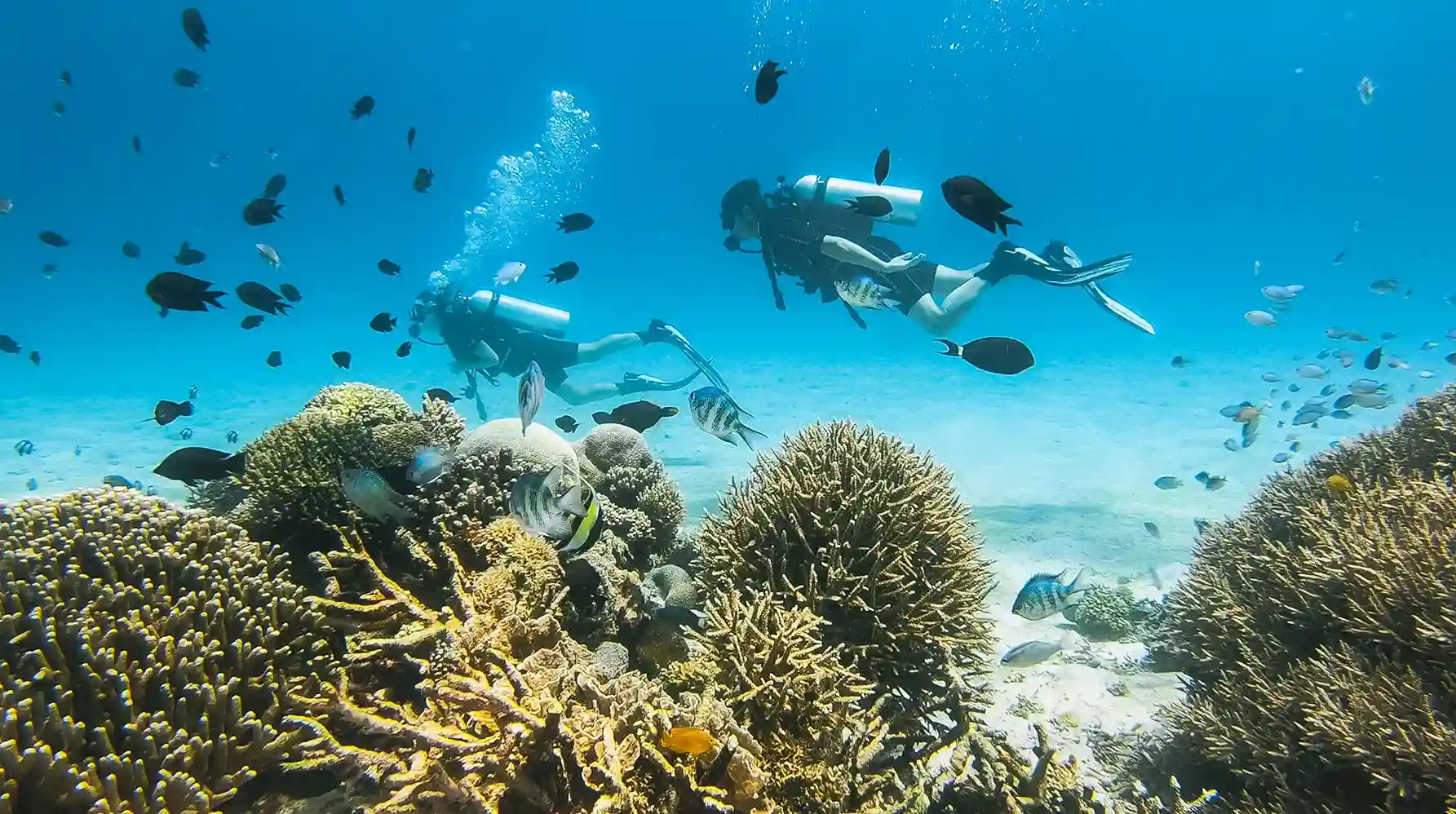
Scuba diving in Komodo National Park is offered only by licensed dive liveaboards and dive operators with certified guides, compressors and tanks, while a standard sightseeing phinisi allows snorkelling only. Some tour boats arrange day dives through a partner dive centre that meets you at the site. If diving is your priority, book a dedicated dive vessel from the start.
Is a dedicated dive liveaboard worth it over a regular sightseeing cruise?
For certified divers a Komodo dive liveaboard is generally worth the extra cost, because it delivers three to four dives a day at current-swept sites that sightseeing boats only pass briefly. A regular cruise suits mixed groups where some guests do not dive at all. The two products run different daily schedules and rarely combine well.
Do I need an Advanced Open Water certification to dive Komodo?
Many of Komodo’s signature dive sites sit in strong current and drift conditions, so operators commonly require Advanced Open Water certification or documented equivalent experience, often with a minimum logged-dive count. Sheltered sites remain available to Open Water divers. Requirements are set per operator and per site, so confirm yours in writing before booking a dive package.
Can complete beginners learn to dive in Komodo?
Beginner courses do run in Komodo at sheltered sites near Labuan Bajo, but the park’s strong currents mean many instructors suggest certifying somewhere calmer and arriving already qualified. If you learn here, expect training dives at gentle sites rather than the famous ones. Try-dive and discovery experiences are widely available for guests without certification.
Do Komodo boats supply snorkelling gear?
Basic mask and snorkel are included on most Komodo cruises, but fin availability, sizing and condition vary considerably, especially on budget boats. Regular snorkellers usually bring their own mask for a reliable fit plus a rash vest for sun protection. Confirm whether wetsuits and life jackets are provided free, since non-swimmers depend on those.
Will my cruise definitely stop at Manta Point?
Manta Point appears on virtually every Komodo itinerary, but the stop is conditional because captains skip it when current runs too strong or visibility drops. That is a safety decision rather than cost-cutting. Sightings themselves are never guaranteed, and reputable operators say so upfront instead of promising an encounter in their marketing.
Is swimming with mantas safe if I am nervous in open water?
Manta Point is a drift snorkel in open water with boat traffic nearby, so nervous swimmers should wear a life jacket, stay close to a guide and enter only when the crew signals. Mantas themselves are harmless filter feeders and must never be touched or chased. Watching from the boat instead is a completely acceptable choice.
Which Komodo boats suit underwater photographers?
Underwater photographers in Komodo are best served by smaller dive-focused phinisi that carry camera rinse tanks, charging stations and flexible dive schedules built around light and tide rather than a fixed group timetable. Guest numbers matter as much as equipment, because fewer divers in the water means cleaner images. Ask about tender support and dedicated camera table space.
Are there night activities such as stargazing or bioluminescence?
Komodo’s anchorages sit far from city light, so stargazing from the deck is one of the most consistently praised parts of an overnight cruise. Bioluminescent plankton is sometimes visible in the water at night, particularly when disturbed near the hull, but it is occasional rather than reliable. Some boats also offer sunset flying-fox viewing at the Kalong mangroves.
Visas, park rules and permits
What visa do I need to visit Komodo National Park?
There is no separate Komodo visa; you need valid Indonesian entry permission covering your whole stay, which for most nationalities means a visa exemption, a Visa on Arrival or an e-VOA. Labuan Bajo is a domestic entry point, so you clear immigration in Bali or Jakarta first. Rules change, so verify your own eligibility with official Indonesian sources.
Can I do a Komodo cruise on an Indonesian Visa on Arrival?
Most international visitors sail Komodo on a standard Indonesian Visa on Arrival or e-VOA, which permits tourism activities including cruises in Flores and Komodo National Park. VOA is typically issued for 30 days and can usually be extended once. Eligibility depends on nationality and current regulations, so confirm your status through official immigration channels before travelling.
What happens if I overstay my visa while in Labuan Bajo?
Overstaying an Indonesian visa is a legal violation that can lead to daily fines, deportation or detention, and it is not something a cruise operator can resolve for you. Resolve your immigration status before continuing to travel or boarding a multi-day cruise. Immigration checks do occur in tourist areas, including at the airport serving Labuan Bajo.
Are there vaccination or health requirements for Komodo?
There are no Komodo-specific vaccination requirements, and standard Indonesia travel health advice applies: routine vaccinations up to date, protection against mosquito bites, and care with sun exposure and food hygiene. There is no decompression chamber inside the park. Discuss your own medical situation and any dive plans with a licensed travel-health professional before departure.
Do I need to bring my passport on the cruise?
Bring your original passport on a Komodo cruise, because operators often need it for park registration and harbour manifest paperwork, and a photocopy alone is not always accepted. Keep it in a waterproof pouch inside a dry bag. Send your passport details to your operator at booking so the manifest can be prepared in advance.
Do I need a permit to fly a drone over Padar or Pink Beach?
Drone use inside Komodo National Park is regulated, and operators generally require park permission, with fees and specific restricted zones that change over time. Do not assume that launching from a boat is exempt. Ask your operator to check the current rule for your travel dates, and be prepared for either a fee or a refusal.
Are there daily visitor limits at Padar or Komodo Island?
Visitor caps and advance booking systems for Komodo National Park have been proposed and revised several times by the authorities, so the rule that applies depends on your travel date. Because these policies keep changing, the practical safeguard is booking through an operator who tracks current park regulations and handles any required registration inside your package.
Can I stay overnight on Komodo Island or camp inside the park?
Overnight stays on Komodo Island and camping inside the national park are not offered to ordinary visitors; guests sleep on boats at anchor or in Labuan Bajo hotels. The ranger stations on Komodo and Rinca are staff accommodation rather than guest lodging. Sleeping on a boat within park waters is the standard and permitted way to catch sunrise there.
Disclaimer: the visa, immigration, park fee and permit information on this page is general travel guidance for planning purposes only. It is not legal, immigration or financial advice. Indonesian entry rules, Komodo National Park fees and visitor regulations change without notice and vary by nationality and travel date. Verify your own situation with official Indonesian immigration and national park sources, or with a licensed professional, before you book or travel.
Packing, connectivity and practical tips
What should I pack for a 3D2N Komodo cruise?
Pack light quick-dry clothing, a swimsuit, reef-safe sunscreen, a wide-brim hat, sunglasses, sandals plus closed shoes for the Padar and dragon treks, a light jacket for night sailing, a dry bag, a power bank, a reusable bottle, motion-sickness tablets and any personal medication. Cabins are small, so a soft bag packs away better than a hard suitcase.
Will the boat provide reef-safe sunscreen?
Reef-safe sunscreen is rarely provided on Komodo boats, so bring your own and choose a mineral formula without oxybenzone or octinoxate. Komodo National Park’s reefs are the reason the cruise exists, and conventional sunscreen washes straight off at every snorkel stop. A rash vest and hat also cut the amount of sunscreen you need in the first place.
Are there ATMs near the harbour in Labuan Bajo?
Labuan Bajo town has several ATMs within walking distance of the harbour area, but withdrawal limits apply and machines occasionally run empty during peak season. Draw the cash you need for park fees, tips and drinks before boarding, because there is no card payment and no ATM once you leave port.
Will my eSIM work around Komodo, or do I need a local SIM?
An Indonesian local SIM or a local-network eSIM generally gives better coverage and value around Labuan Bajo than an international roaming plan, though no provider covers most of the national park. Signal reappears near a few islands and on the approach back to town. Buy and activate the SIM in Bali or Labuan Bajo before boarding.
Is there luggage storage in Labuan Bajo during the cruise?
Most Labuan Bajo hotels store guests’ extra luggage free of charge during a cruise, and many operators will also hold bags at their office. Cabins are compact, so taking only a small soft bag on board is normal practice. Never leave passports, cash or electronics in stored luggage, and photograph your bag when you hand it over.
Is English widely spoken on the boats and by park rangers?
Basic to good English is standard among guides and Komodo National Park rangers who work with international visitors, and cruise guides on mid-range and luxury boats are generally fluent. Deck crew and cooks may speak limited English. If you need another language, request a specific guide at booking, since availability is limited and must be arranged ahead.
Changes, cancellations and common problems
What happens if bad weather cancels my Komodo cruise?
When a captain or the Labuan Bajo harbour authority cancels a Komodo cruise for weather, operators typically offer a reschedule to the next available departure or a partial refund, with terms set by each company’s own policy. Cancellations are most frequent from December to March. Read the weather clause before you pay, and keep one buffer day in Labuan Bajo during rainy season.
What compensation is normal if the trip is cut short by engine trouble?
Compensation for a shortened Komodo cruise varies by operator and usually takes the form of a partial refund, a transfer to another boat or a future credit rather than a fixed formula. Whatever is offered, document the problem with photos, timestamps and written messages at the time. Travel insurance is often the more reliable route to recovery.
What goes wrong most often on Komodo cruises?
The three recurring complaints are weather cancellations, budget boats delivering food or cabins below what was advertised, and disputes over what the price included, most often Komodo National Park fees. All three are reduced by the same discipline: a named vessel, dated photos, a written itinerary and an explicit list of inclusions and exclusions before payment.
How do I avoid being sold a lower-standard boat than advertised?
Insist on the actual Komodo vessel name rather than a class label, request recent dated photos of the specific cabin you are buying, read independent reviews from the last few months, and get the safety equipment list and inclusions in writing. If an agent will not name the boat or send current photos, book elsewhere.
Can I change the itinerary once I am on board?
Private charters can adjust the plan on the water within the agreed fuel allowance and safety limits, so extra time at Pink Beach or a swapped anchorage is usually possible. Open trips run a fixed schedule shared by every guest and cannot be changed for one party. Mid-cruise extensions depend on cabin availability and are uncommon.
Plan your Komodo cruise
Ready to compare a shared cabin against a private phinisi for your own dates? Send your travel dates, group size and preferred trip length on WhatsApp at https://wa.me/628113823875 or email [email protected], and we will reply with a written quote, the named vessel, the full inclusion list and exactly which Komodo National Park fees apply to your departure. Every price on this page is indicative and confirmed only in writing.
Explore More Komodo Cruise
Browse guides, itineraries and everything you need to plan your cruise.